Originally posted in 2011
***SPOILER ALERT***
 As I am debating on reducing my Netflix (a whole other post) to either DVD or stream only, facing the impending price hike in September, I’ve been taking advantage of the streaming option as much as possible.
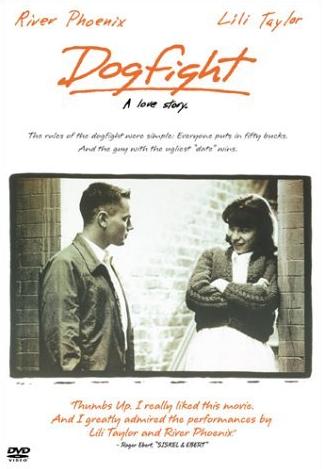
Last night, I settled on “Dogfight,” a relatively unknown film from 1991, starring River Phoenix and Lili Taylor, released two years before his tragic death.
Set in 1963, Phoenix stars as Eddie Birdlace, an 18-year-old Marine, who is spending his last night stateside in San Francisco, shipping off to Vietnam just before the war heats up. Lili Taylor co-stars as Rose, a local waitress and aspiring singer/songwriter.
Birdlace and his fellow Marines are invited to a “Dogfight” – the goal being the Marine who brings the ugliest date wins a cash prize. Awesome, right?
Birdlace wanders into Rose’s Cafe, owned by Rose’s mother, and finds Rose, quietly practicing guitar. She is not ugly, but shy, and a bit awkward, and as the viewer comes to learn, sharp and witty.
He invites her to the dogfight, but is immediately hesitant, trying to get her to go somewhere else, to no avail. She learns from another girl at the party the true meaning of the evening, and returns home after slapping Birdlace at the bar.
Here is where River Phoenix’s talent really becomes alive in the movie. He’s comedic, yet endearing, confident in himself, but not at all confident around Rose. He’s charming, in sort of a brash way, but is still also just 18 years old.
Rose is finally convinced to go out to dinner with Birdlace, and the two set off for a night they will never forget. Phoenix’s facial expressions give so much insight into his character’s building feelings for Rose.
Rose talks of her dream to become a singer/songwriter but expresses stage fright and lack of confidence in her talents. She brings Birdlace to a local cafe/performance space, to show him where she envisions herself performing one day, and he convinces her to play something.
She begins tepidly, warming up to the idea as she is seated at a piano, and he sits at a table, smoking and watching her. It’s a touching moment, an intimate moment, probably more so than any other in the movie because she is performing only for him.
The two continue on in their journey of San Francisco to an arcade, which has a room full of coin operated music machines. Birdlace runs around the room, putting a coin in each, watching as Rose’s face lights up with delight.
It is in this music room that the two share a perfectly awkward kiss, and I really applaud the director for not making it glamorous and Hollywood, but showing instead how a first kiss may truly be between two teenagers. Phoenix shows such vulnerability in this scene, as Rose’s nerves show through.
The comedy returns again, when upon walking Rose to her door, she invites him in. She decides to change into a long-sleeved nightgown, which just seemed so silly, as Birdlace strips down to his underwear and hops in her bed. And while it is implied they sleep together, it isn’t shown, which I appreciated, for their relationship has been more about their emotions than physical interaction.
Birdlace leaves as the sun is rising, heading back to the bus station to meet up with the rest of his group. She hands him her address, and as he walks up the street, Rose smiles sadly, she knows she may never see him again.
The final scenes of the movie I believe are the most powerful. We’ve skipped 3 years ahead, after Birdlace has recovered from losing a friend and a severe injury in Vietnam. He returns to a hippie San Francisco, singled out for his Marine clothing. As he walks down Rose’s street, towards the cafe, he quickly crosses and enters a bar nearby.
He inquires about the cafe, and learns that Rose’s mother left it to her. He paces in front of the window, watching Rose exit the cafe. Again Phoenix’s facial expressions are perfection. He emits worry, nerves, and indecision, before finally adjusting his hat, finishing his drink, and making his way across the street.
The last scene is truly beautiful. Birdlace enters the cafe, unsure of himself, standing in the doorway, watching Rose as she wipes glasses dry. She turns, realizes it is him standing in her cafe, and tears well up. “Hi,” she says, and walks over to him. They gaze at each other before finally hugging. A review I read called this hug “ambiguous,” but I did not see ambiguity. I saw relief, emotion, belonging. Birdlace holds onto her for dear life, while her eyes fill with tears, and she stands on tiptoe to wrap her arms around him. There is no dialogue needed; it is all in the embrace.
Ironically, the last scene was actually the first filmed, and apparently Phoenix was upset, since he hadn’t filmed anything prior to get him into character. It just goes to show how much he really embodied the character and filled out the nuances of Birdlace.
Both Taylor and Phoenix do a phenomenal job in relaying the emotion that surely built up in their characters over the prior 3 years. It is implied somewhat that perhaps he had not written, or at least not in a long time. Rose’s relief that he is alive, Birdlace’s relief that he found her.
An excellent film, made excellent by Taylor and Phoenix. Phoenix’s raw vulnerability in the movie really brought out the emotions of Birdlace, while Taylor’s Rose grew in her confidence and strength.
I’ve always been a huge River Phoenix fan. I think the world lost out on a truly incredible actor and musician when he died. This performance captures his youth and abilities so well, it’s a tribute to a person that would die before his dreams could be fully realized.
 headphones are on