***Spoiler Alert***
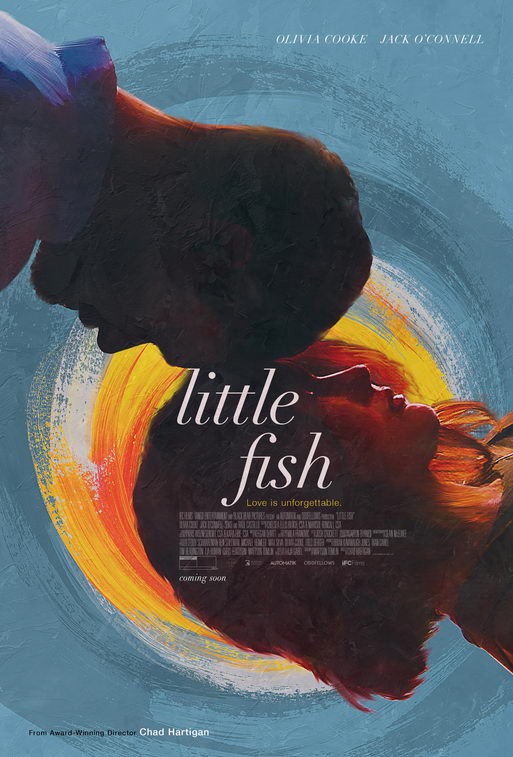
Another casualty of the COVID-19 pandemic, the film “Little Fish” was supposed to premiere at the 2020 Tribeca Film Festival. To everyone’s benefit, it was picked up by IFC Films later in the year, and finally released in both theaters and on demand on February 5, 2021. In a truly surreal turn, “Little Fish” is centered around a pandemic, based on a short story by Aja Gabel that was published in 2011. When the film was originally announced, it had that almost quaint dystopian vibe of the late 2000’s and early 2010’s. It was filmed before the term COVID-19 was even coined, and yet in what seems to be a true moment of fate, it’s release falls just short of a year into the darkest time most of us have ever seen.
Starring Jack O’Connell, Oliva Cooke, Raul Castillo, and Soko, the screenplay was written by Mattson Tomlin and directed by Chad Hartigan. The film is a true indie flick in both content and it’s actors. As a long time fan of Jack O’Connell, I’ve been waiting for the film to come out since the project had been announced. O’Connell’s work is still largely under the radar in the US, where he is most known for the harrowing leading role in the 2014 film “Unbroken”, and also stars in the Netflix series, “Godless”, and the recently released “Jungleland”. But for those of us in the know, he came up on the legendary UK show “Skins”, arguably inhabiting one of the best characters of all time, Cook. If you haven’t seen it, watch immediately. Cooke, Castillo, and Soko all have deep resumes, particularly Castillo in theatre.
Set in Seattle in the near future, the “Little Fish” pandemic is neuroinflammatory affliction, or NIA. It sets on slowly or all at once, stealing your memories and making you forget the people around you, and eventually, your own self. Is that not one of the greatest human fears? To lose your memory, out of nowhere. To lose it slowly in fragments, like Alzheimer’s. And there is no cure, either way.
To say it was surreal watching this in February 2021 is an understatement. Deep into the COVID pandemic and heavily isolated due to my own circumstances, it was like watching the last year play out. The rumblings of a new virus with no cure, the slow rise and then tidal wave of panic as the virus spreads across the nation with no stopping it. The desperation to see family and friends that are out of town, out of state, out of the country. The use of surgical masks. The loss of a friend, a co-worker, a neighbor. Your familiar surroundings degenerating into a physical sign of the world grinding to a halt.
The film plays out Jude (O’Connell) and Emma (Cooke)’s relationship, going back and forth between the present and the past. Little nuances in the scenes point to each of them remembering something slightly differently. Is that a sign of NIA? Or is it a sign of how people remember things differently, what stands out as being most important? A detail that isn’t deemed significant enough to remain in the memory for one, stays with another. It’s a topic that has been explored in many ways through film and writing, but when there’s a virus that may be the cause of these discrepancies, the question becomes: Am I actually forgetting?
The mind has an incredible ability to replace and rework. And as the characters struggle with NIA, you see that their minds are taking bits and pieces of what they do remember, and filling them in. Like a coloring book with lines of the event, each of their minds chooses a different shade for a dress, a different time of the year, a different bit of dialogue to fill in a missing line. You begin to create different histories, based on the knowledge that you love the other person, but you can’t remember exactly why or how you got to that point.
A running theme in the film is that of touch, a haptic memory. It is a sensory memory created by touching or feeling something. Emma mentions it to Jude early on after they discover he is in fact suffering from NIA, and it becomes the grounding point for both of them. A reminder of how they feel to each other, literally, but also how they feel about each other emotionally. As Jude’s memory continues to decline, you can see that there is still a high level of function in their relationship. He doesn’t always remember who Emma is, but somewhere deep down, he remembers that they belong together.
As the film reaches its final act, it becomes obvious that Emma has NIA as well, and her memory is starting to slip in bits and pieces. She is relied on as the narrator throughout, literally narrating their story on paper. But is anything she said really reliable? At what point does her actual memory of their time together become like Jude’s – having the framework of their history, but her mind filling in the now missing pieces.
The final scenes play out the moments they both finally forget each other, echoing back to the opening scene of the film, which was really the end of their story as Emma and Jude with NIA. For Jude its like a slow crackling, he’s there and he’s not, before the pieces finally fall away. And that triggers Emma’s remaining memories to collapse and wash out to sea all at once. And yet, they are both still on the beach, with their dog, and something draws them to each other again. A new life for the new Jude and Emma, who don’t remember each other, but are still married? It’s an interesting thought, maybe those haptic memories stay, a feeling of connection stays, while the details are taken by NIA.
Small moments are what make life. The day to day that builds a long term relationship creates the foundation of that relationship. We all remember things a bit differently, and those memories shape how we feel about another person, even with those variances. But to lose the memories altogether, what does remain of a relationship between two people? Is there more than just memories, a physical familiarity and attachment to that person, that stays even when the mind is going? It seems to be true, as in the case of Jude and Emma, that some people will always just be drawn to each other, no matter the circumstances.
While “Little Fish” would’ve been a strong film pre-COVID, it’s ability now to provide a relatable experience and emotional outlet makes the story that much more powerful. For many of us, COVID has pushed us to reevaluate priorities, strengthen relationships, document pandemic life, make the most of the moments we have day to day. There are several projects in the works that are COVID centric, but what I like the most about “Little Fish” is that by some strange turn of events, it was created in the last months of pre-COVID innocence, and it brilliantly portrays how something so massive leaks into every crack, until it takes over your life, and it itself is a veteran now of COVID times.
“Little Fish” is available for rent and purchase on a variety of platforms, including Apple TV and Amazon.
The original short story, “Little Fish”, by Aja Gabel, has been republished by Entertainment Weekly here
 headphones are on